Secrets Behind Foldable Screens Lasting 200,000 Folds | BOE Flexible Display Technology

Foldable screen technology achieves remarkable durability through precise engineering and advanced materials. The waterdrop hinge design increases the fold radius and reduces stress, while a multi-layer structure protects each component. Engineers use digital simulation and rigorous testing to ensure these foldable screens withstand 200,000 folds, a benchmark now recognized as an industry standard. Concerns about the longevity of flexible panels highlight why users value these improvements. Foldable Screen Technology sets new expectations for reliability in daily use.
Key Takeaways
Foldable screens can last over 200,000 folds due to advanced engineering and innovative materials.
The waterdrop hinge design reduces stress on the screen, allowing for smoother folds and increased durability.
A multi-layer structure protects each component, balancing strength and flexibility for long-term use.
Innovations like ultra-thin glass and flexible polymers enhance the resilience and performance of foldable screens.
Digital simulations and rigorous testing ensure that foldable screens meet high durability standards before production.
Proper care, such as using a protective case and keeping the hinge clean, can significantly extend the lifespan of foldable devices.
Understanding common failure points, such as hinge weakness and screen creasing, helps users take preventive measures.
Future trends in foldable technology include eco-friendly designs and multi-fold displays, promising even greater reliability.
The Core of Foldable Screen Technology
Foldable screen technology stands at the intersection of advanced engineering and innovative materials. This technology allows devices to bend and flex thousands of times while maintaining performance and reliability. The following sections explain the main breakthroughs that make this possible.
Engineering Breakthroughs
Early foldable screns often used a U-shaped hinge disign, which has many limitions caused by highly concerntrated stress. Engineers have developed several key solutions to improve the durability of foldable screens. The waterdrop hinge design represents a major leap forward. This hinge lets the device fold flat, which reduces the visibility of the crease and lowers the stress on the screen. The design also makes the device thinner, which increases overall durability.
The waterdrop hinge distributes stress more evenly across the fold, preventing damage and extending the life of the flexible display technology.
A comparison of recent engineering advances highlights the progress in foldable screen technology:
Breakthrough | Description |
|---|---|
Armor FlexHinge | 27% thinner and 43% lighter than previous versions, with upgraded alloy components increasing yield strength by over 14%. |
Display Thickness | Reduced by more than 39% through optimization and advanced materials. |
Material Innovation | Titanium-based lattice replaces carbon fiber for 64% improved durability. |
Ultra Thin Glass | 50% thicker than previous versions, enhancing performance and reducing crease visibility. |
These advances allow foldable screens to withstand over 200,000 folds. Engineers use digital modeling to optimize the thickness and stacking order of each layer, which helps manage stress during folding. The result is a flexible screen that maintains its function and appearance even after extensive use.
Material Innovations
Material science plays a crucial role in the success of foldable screen technology. Manufacturers use a multi-layer structure to balance strength, flexibility, and touch sensitivity. Each layer serves a specific purpose, working together to protect the screen and ensure long-term durability.
Material Type | Role in Durability |
|---|---|
Polyimide | High heat resistance, replaces glass in foldables |
Colorless Polyimide | Strengthens cover window, enhances protection |
Multi-buffer | Improves flexibility of the display |
Specialized TFT | Increases reliability of the display |
OCA | Absorbs strain, helps design neutral planes |
Hinge Mechanism | Distributes stress during folding, maintains flatness |
Manufacturers have also introduced new adhesive solutions and tapes to further improve flexible display technology. These include optically clear adhesives that maintain clarity and strong bonding through repeated folding, shock-resistant adhesives for impact protection, and thermal management tapes to prevent overheating. Ultra-thin glass covers add a layer of hardness while remaining flexible, and colorless polyimide layers provide extra protection without sacrificing clarity.
The optimization of each material layer, from polyimide to ultra-thin glass, ensures that the foldable screen can handle daily use and environmental challenges.
Engineers continue to develop thin and flexible materials, such as atomically thin 2D materials, to improve electrical conductivity and durability. The combination of these innovations allows foldable devices to deliver a reliable and satisfying user experience.
BOE's Waterdrop Hinge and Structural Design

The waterdrop hinge stands at the heart of modern foldable screen durability. This unique approach in hinge engineering changes how devices bend, directly impacting stress distribution and overall lifespan.
Mechanical Breakthrough of the Waterdrop Design
BOE’s innovative Waterdrop (Teardrop) Hinge Design achieves a leap in mechanical performance by reimagining the spatial trajectory of the screen during folding:
Space Buffer Principle: The screen forms a waterdrop-like cavity when folded, increasing the bend radius by 2-3 times and significantly dispersing stress distribution.
Multi-Layer Coordinated Bending: Each layer of the display module bends with a gradient deformation, avoiding local over-stretching or compression.
190,000+ Cycle Certification: This design enables inward-folding screens to pass rigorous tests of over 190,000 folds, far exceeding conventional industry standards—equivalent to over 5 years of use with 100 folds per day.
Stress Distribution
When a device folds, the screen experiences significant mechanical stress. Traditional U-shaped hinges force the display to bend sharply, which concentrates stress in a narrow area. BOE's Waterdrop (Teardrop) Hinge Design, however, allows the screen to fold into a gentler curve - Space Buffer Principle: The screen forms a waterdrop-like cavity when folded, increasing the bend radius by 2-3 times and significantly dispersing stress distribution.
Aspect | Description |
|---|---|
Design | The waterdrop hinge allows the display to fold into a gentler radius. |
Stress Distribution | This design minimizes screen creasing, which reduces stress on the display during folding cycles. |
Durability | Enhances device durability by addressing concerns regarding display longevity. |
By distributing stress more evenly, the waterdrop hinge helps the screen survive repeated bend cycles. Devices with this design can bend thousands of times without visible damage, making them more reliable for daily use.
Multi-Layer Bending
Foldable screens use a multi-layer structure to handle the repeated bend cycles. Each layer bends in a coordinated way, which prevents any single layer from taking all the strain. This method reduces the risk of failure and extends the device’s usable life.
BOE's Waterdrop Hinge Design makes each layer of the display module bend with a gradient deformation to keep the stress low across all layers. This approach allows the screen to bend smoothly, reducing the chance of delamination or cracking. Engineers design each layer to flex in harmony, which supports the screen’s ability to bend repeatedly.
190,000+ Cycle Certification
BOE's Waterdrop Hinge Design enables inward-folding screens to pass rigorous tests of over 190,000 folds, far exceeding conventional industry standards—equivalent to over 5 years of use with 100 folds per day.
Systems Engineering via 3D Structural Optimization
BOE engineers optimized the hinge area at a micro-structural level using 3D Finite Element Analysis:
Stress Diffusion Grid: A micron-level stress-guiding structure in the bend zone disperses concentrated stress to non-display areas.
Dynamic Gap Control: The distance between layers adapts during opening and closing to prevent friction damage.
Folding Trajectory Optimization: Precise control of the screen’s motion curve from unfolded to folded states ensures smooth, shock-free operation.
The combination of a waterdrop hinge, multi-layer bending, 19,000+ Cycle Certification and 3D optimization creates a foldable screen that can bend repeatedly while maintaining strength and performance.
BOE’s Advanced Materials for Durability
Seven-Layer Architecture
The seven-layer architecture in foldable screens combines multiple advanced materials to achieve a balance between hardness, flexibility, and touch experience. Each layer serves a specific function, working together to protect the screen and maintain frame integrity.
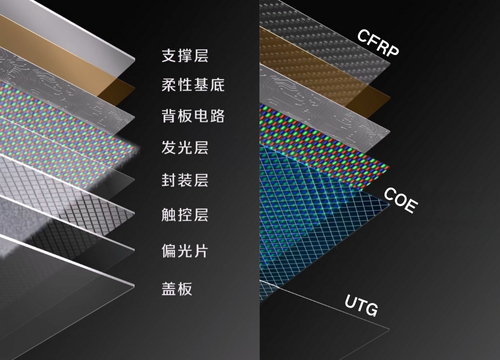
Support Layer: Skeleton Technology That Balances Rigidity and Flexibility
BOE achieves innovative material fusion in the support layer:
SUS Stainless Steel Precision Mesh
Medical-grade stainless steel, thickness controlled at ~0.03mm
Laser-etched honeycomb microstructure with over 90% open area
Reinforced "safety island" design at key hinge points
CFRP Carbon Fiber Composite Layer
Carbon fiber weave angles optimized via simulation for anisotropic mechanical properties
Density just two-thirds that of aluminum, yet 200% stronger
Multi-layer ply design with fibers oriented to handle different stress types
Display Core Layer: The Delicate Balance of Light Emission and Protection
Flexible Polymers
Flexible polymers contribute to the resilience and adaptability of foldable screens. These materials allow the screen to bend, twist, and return to its original shape without damage. BOE Flexible display technology, which uses these polymers, creates ultra-thin and lightweight screens. The absence of a backlight in OLED panels gives designers more freedom to create innovative shapes and supports a small curvature radius, often as tight as 1mm.
BOE flexible panels enable lightweight, highly bendable screens that support advanced frame designs.
The lack of a backlight allows for creative product shapes and improved frame strength.
These panels achieve a small curvature radius, which is essential for crease minimization and screen resilience.
Flexible printed circuit films, made from extensible materials, segment into sub-base films. This design distributes mechanical stress, improving frame integrity and internal component protection.
Flexible polymers also enhance water and dust resistance by forming tight seals around the frame and screen. These materials ensure that the device maintains its durability and resilience, even in challenging environments.
Backplane Circuit Innovation
Oxide semiconductor TFT array with serpentine routing in bend zones
Redundant circuit layout at critical nodes; single-point failure doesn’t affect overall function
Elastic conductive materials maintain conductivity even at >30% stretch
Breakthroughs in Light Emission and Encapsulation
RGB self-emissive pixels, each sub-pixel independently encapsulated
Thin-Film Encapsulation (TFE) with alternating inorganic/organic layers blocking moisture/oxygen
Water oxygen transmission rate <10⁻⁶ g/m²·day, matching rigid OLED levels
Surface Layer: Perfect Unity of Touch Feel and Durability
UTG (Ultra-Thin Glass) Flexible Glass Cover
Ultra-thin glass (UTG) stands as a core material in BOE's foldable screen technology. Manufacturers select UTG for its unique combination of flexibility and strength. This glass can bend to a radius of less than 1mm, which is essential for devices that require frequent folding. Chemical strengthening processes further enhance its durability, allowing the screen to withstand more than 300,000 bend cycles without failure. The following highlights the properties that make UTG ideal for foldable screens:
Thickness only 30-50 microns, comparable to a human hair
Chemically strengthened with surface compressive stress layer >20µm deep
Maintains >95% strength after bend fatigue testing
Intelligent Choice Between CPI and UTG
CPI (Colorless Polyimide): For large curvature folding, extreme bend radius <1mm
UTG (Ultra-Thin Glass): Provides glass-like feel, hardness up to 7H+
Hybrid Solutions: Different materials in different zones for optimal performance
Integrated Touch COE Technology
Embeds touch sensors inside the encapsulation layer, eliminating separate touch film
Reduces overall thickness by 20%, improves optical performance by 15%
Touch lines and pixel circuits co-designed to avoid signal interference
Digital Simulation and Testing
Digital simulation and testing form the backbone of foldable screen durability. Engineers use advanced modeling and rigorous lab tests to ensure each device meets high standards for reliability and performance.
Multi-Parameter Digital Modeling System
BOE built a simulation database with over 20 core parameters:
Material Constitutive Model Library
Key indicators: elastic modulus, Poisson's ratio, yield strength, creep parameters
Material performance curves under varying temperature/humidity
Fatigue accumulation damage models predict material lifespan decay
Structural Response Simulation System
Nonlinear contact analysis: Simulates interaction between layers during folding
Buckling/post-buckling analysis: Predicts instability under extreme bending
Vibration/shock simulation: Evaluates drop resistance in folded state
Digital Validation of Form Factor Innovation
Mature Application of Dual-Fold Technology
Optimized hinge stress distribution via tens of millions of element simulations
Bend radius optimized from 3mm down to 1.5mm for smaller folded volume
Unfolded flatness <0.1mm curvature; virtually no visible crease
Tri-Fold Breakthrough: World's First Hybrid Folding Solution
Inward + outward coordinated design: Middle section folds outward, sides fold inward for Z-shaped fold
Synchronized multi-hinge system: Multiple hinges联动 for consistent folding motion
Form switch algorithm: Automatically adjusts display area based on opening angle
10:1 thickness ratio from fully unfolded to fully folded
Quad-Fold Prototyping
Lab prototype completed; target fold cycles >250,000
Segmented hinge design: Adaptive bend radii in different zones
Form switching time <1 second; mechanical reliability meets industrial standards
Precision Translation from Tech to Product
Smart Device Applications
Foldable laptops: 13.3-inch foldable screen unfolds into full-sized keyboard area
Foldable phones: Seamless switching between inner/outer screens; industry-leading crease control
All-in-one smart displays: 55-inch rollable TV with 80% smaller storage volume
Automotive displays: Pillar-to-pillar dashboard with局部折叠 for different driving modes
Mass Production Process Innovations
Laser lift-off process: Transfers flexible screen from rigid carrier with 98% yield
High-precision alignment system: Layer-to-layer alignment accuracy <3µm
In-line optical inspection: 100% screen area defect detection at pixel-level精度
Automated bend testing: Each screen undergoes 5,000 pre-folding cycles before leaving factory
Industry Standards
Industry standards set clear benchmarks for foldable screen durability. These standards cover physical performance, comfort, and reliability in various scenarios.
Pillar | Description |
|---|---|
Physical Performance | Ensures resilience against wear and tear, guaranteeing durability. |
Holding Comfort | Assesses ergonomics to guarantee maximum comfort for users. |
Scene Durability Testing | Simulates real-life scenarios to ensure devices withstand everyday challenges. |
Folding Endurance | Includes rigorous folding tests, pushing devices up to ten-thousands of folds for longevity. |
Extreme Usage Scenarios | Tests devices under extreme conditions, such as high temperatures and cold weather. |
Consistent Quality Assurance | Ensures devices remain in prime condition after rigorous evaluations, with no discernible changes. |
Some foldable screens pass military-grade tests, such as the US MIL-STD 810G, which checks durability against shock, temperature, and environmental stress. These certifications show that the screen can handle demanding conditions and maintain reliability over time.
Automated testing processes and strict industry standards ensure that every foldable device delivers consistent performance and long-lasting durability.
Foldable Screen Durability in Real Life
Common Failure Points
The most frequent potential durability issues in foldable phones appear in specific areas. The table below lists common failure points and their descriptions:
Failure Point | Description |
|---|---|
Hinge Weakness & Failure | The hinge can wear out or break after repeated use, leading to operational problems. |
Screen Creasing & Delamination | The flexible screen may develop visible creases or layers may separate over time. |
Dust Intrusion & Water Resistance | Gaps in the hinge can let dust enter, damaging the screen and internal parts. |
Screen Durability | The screen is more likely to get scratches or punctures than traditional glass. |
Impact Damage | Drops can cause damage, especially to the hinge or screen area. |
These failure points highlight why practical considerations for enhancing fold phone durability matter. Users should understand where problems can occur and take steps to avoid them.
Care and Maintenance
Proper care helps maximize fold phone durability and keep the device in good condition. Here are some tips for daily use:
Store the device in a safe pocket or bag to prevent accidental drops or pressure.
Avoid do-it-yourself repairs, as these can cause more harm than good.
Use wireless charging when possible to reduce wear on charging ports.
Keep hands clean before using the screen to prevent residue buildup.
Update software regularly for the best performance and security.
Schedule professional maintenance checks for expert inspection and cleaning.
Tip: Handle the foldable gently and avoid folding or unfolding it too quickly. This simple habit can extend the life of a durable fold phone.
By following these steps, users can address potential durability issues and enjoy a longer-lasting device. Foldable screen durability depends on both advanced engineering and smart daily habits.
The Future of Folding Phone Screens
Multi-Fold and Stretchable Displays
Folding phone screens are entering a new era with the development of multi-fold and stretchable displays. Engineers are designing screens that can fold not just once, but multiple times, creating devices that transform from compact phones into large tablets or even laptops. Stretchable displays push the boundaries further, allowing the screen to expand and contract like elastic. These innovations increase versatility and open up new possibilities for device design.
Researchers have introduced several advanced features to improve the performance of folding phone screens:
Innovation | Description |
|---|---|
Hidden Active Area (HAA) | A three-dimensional pixel design in stretchable OLEDs maintains over 87% fill factor after 30% biaxial strain. |
Strain-Sensor-in-Pixel (S-SIP) | Miniature strain sensors within pixel circuits detect real-time strain and adjust pixels dynamically. |
Distribution Density-Aware Compensation (DDAM) | Adjusts pixel activation density based on stretch and viewing conditions, improving image quality. |
These technologies help folding phone screens maintain brightness, color, and clarity even when stretched or folded in complex ways. Enhanced durability, advanced hinge mechanisms, and scratch-resistant coatings also play a role in making future folding phone screens more reliable.
Eco-Friendly and Repairable Designs
The future of folding phone screens includes a strong focus on environmental responsibility. Manufacturers are adopting eco-design frameworks that prioritize recyclable materials and energy-efficient manufacturing. The European Commission has introduced ecodesign legislation that encourages companies to use modular components and provide spare parts for at least five years. This approach aims to reduce electronic waste and extend the lifespan of devices.
Companies are integrating biodegradable substrates and non-toxic encapsulation layers to lower the environmental impact of folding phone screens.
Modular, repairable designs allow users to replace damaged parts, supporting longer product lifecycles and reducing e-waste.
The industry is balancing innovation with sustainability, making folding phone screens both advanced and eco-friendly.
These changes address some of the pros and cons of folding phone screens, especially concerns about repairability and environmental impact.
Market Trends and Innovations
Folding phone screens are shaping new trends in the electronics market. The rise of OLED technology provides better viewing angles and contrast, improving the user experience. Manufacturers are launching new products with sleek designs and user-friendly interfaces. Curved foldable displays combine aesthetics with functionality, appealing to consumers who want modern devices.
Trend/Innovation | Description |
|---|---|
Rise of OLED Technology | OLEDs enhance visual experience with better contrast and viewing angles. |
Integration in Automotive Applications | Foldable screens are used in vehicle navigation and infotainment systems. |
Focus on Sleek Designs | Products feature attractive aesthetics and easy-to-use interfaces. |
New Product Launches | Companies introduce advanced folding phone screens with innovative features. |
Curved Foldable Displays | These displays offer both style and practicality. |
Technological Advancements | Slimmer, more efficient folding phone screens are entering the market. |
Industry standards are evolving to support these innovations. Automated precision assembly lines and AI-driven quality control are reducing production costs. Regulatory shifts emphasize sustainable materials and energy-efficient processes. Manufacturers continue to invest in research and development to address durability challenges and meet consumer expectations.
Folding phone screens are becoming more common in wearables and automotive applications. As the market grows, consumers will see more options and improved features. Understanding the pros and cons of folding phone screens helps buyers make informed decisions as technology advances.
Foldable screens achieve remarkable durability through a blend of advanced engineering, innovative materials, and rigorous testing. The table below highlights how each aspect contributes:
Aspect | Contribution to Durability |
|---|---|
Hinge Design | Multi-directional hinges improve flexibility and robustness. |
Material Innovation | Ultra-thin glass resists scratches and maintains flexibility. |
Testing Protocols | Strict testing ensures screens withstand thousands of folds. |
Consumers can extend device lifespan by following these steps:
Use a case designed for foldable phones.
Keep the hinge area clean.
Apply a foldable screen protector.
Avoid over-bending the device.
Update software regularly.
Ongoing innovations, such as self-healing materials and rollable displays, promise even greater reliability and versatility for future foldable devices.
FAQ
What makes foldable screens last over 200,000 folds?
Engineers use waterdrop hinges, multi-layer materials, and digital simulations. These features distribute stress and prevent damage during repeated folding.
What materials protect foldable screens from damage?
Manufacturers use ultra-thin glass, polyimide, and carbon fiber reinforced polymers. Each layer adds strength, flexibility, and resistance to scratches.
What testing methods confirm foldable screen durability?
Technicians run automated folding machines and environmental tests. These methods check for creasing, delamination, and touch sensitivity after thousands of folds.
What care tips help extend the life of a foldable screen?
Users should keep the hinge clean, use a protective case, and avoid rapid folding. Regular software updates and professional maintenance also help.
What common issues affect foldable screen durability?
Hinge wear, screen creasing, dust intrusion, and impact damage can occur. Proper design and user care reduce these risks.
What future trends will improve foldable screen reliability?
Researchers develop multi-fold, stretchable, and self-healing screens. Eco-friendly materials and modular designs will support longer device lifespans.
What role does the waterdrop hinge play in durability?
The waterdrop hinge increases the fold radius. This design spreads stress evenly, reducing the chance of creases and cracks.
What industry standards guide foldable screen quality?
Industry standards require screens to pass folding endurance, environmental, and comfort tests. These benchmarks ensure consistent reliability for users.
See Also
Leading Touch Screen Producers to Watch in 2025
The Energy Efficiency of Multi-Frequency Displays Compared to Traditional Screens
Key Innovations in Digital Museum Screens to Anticipate in 2025
2025 LCD Screens: Innovations Enhancing Clarity and Efficiency
Investigating BOE’s Flexible Display Advances and Their Impact on Consumer Technology